Join the Reddit Community
Foundation
Learn the principles behind every movement.
Introduction
Foundation covers the core principles behind calisthenics training. Think of it as the theoretical part of the course,
where each video explains a concept rather than a particular exercise or workout.
Overview
This section covers four main topics:
Programming - how to create your own calisthenics program.
Progression - how to keep progressing through harder exercises.
Mobility - how to improve your range of motion and movement quality.
Weight loss - how training and diet fit together for fat loss.
Equipment - what equipment is useful and how it affects your training.
Calisthenics as an RPG game
You can think of calisthenics as an RPG game where you are the main character.
The analogy fits well, because to improve you first need to assess your current level.
"How many pull-ups can I do?"
"Do I have pain in my wrists?"
"Do I have any muscle imbalances?"
"Do I have previous injuries?"
and many more
These questions matter because they decide how you should approach your training. Ignore them, and your injury risk goes up while your progress slows down.
Programming
A lot goes into designing a good program, but you do not need to know everything up front.
I only knew a handful of these things when I started, and it did not stop me from training. You learn as you go. Still, it helps to be aware of these concepts.
Periodisation
Periodisation is a method of organising a training program into planned phases.
The modern periodisation model was formalised by Soviet sports scientist Lev Matveyev, who divided training into three main types of cycles:
Macrocycle
- the complete long-term training plan.
It commonly lasts several months to a year and is designed around a major overall goal, such as building muscle, improving strength, or preparing for a competition.Mesocycle
- a specific training phase within the macrocycle.
It usually lasts around three to eight weeks and focuses on a particular objective, such as hypertrophy, maximal strength, muscular endurance, or recovery.Microcycle
- the shortest training cycle. It commonly lasts one week and contains the individual training sessions, exercises, volume, intensity, and recovery days.Application to calisthenics
I already mentioned three stages in the course:
preparation, basics, advanced which we can think of as macrocycles.
Why so many options?
The problem with programming is that the deeper you go into cycles, the more individual factors matter.
A 60-year-old with wrist pain and no background in fitness
will have a totally different program than a 25-year-old with 5 years of lifting experience.
How to warm up?
A warm-up prepares your body for training and helps you move well from the first rep.
A common mistake is overcomplicating it: doing random exercises or turning it into a full workout.
Keep it simple, around 5 to 10 minutes, focused on the joints and movements you are about to use. It should not be hard or long, just enough to prepare your body.
Warm up what you train
And yes - if you plan to train full body, warm up the full body.
Recovery
Training is only the stimulus. You actually get stronger while you recover, so if you never recover you never progress, and your injury risk climbs.
Three levers matter most:
Sleep
- the single most important one. Get enough that you wake up feeling recovered. Poor sleep blunts strength gains and slows tendon repair.Rest days
- keep at least one or two full rest days per week. Light mobility on these days is fine.Deloads
- every so often, drop your volume and intensity for a week to let accumulated fatigue clear.When to deload
If your progress stalls for 2 sessions in a row, or you feel constantly tired and beaten up, take a lighter week. Cut your sets roughly in half and stay well short of failure. You will usually come back stronger.
Tracking
If you do not track your training, you are guessing. Write down each exercise, and for it the sets, reps, and hold times you managed.
This matters because progression depends on it. The whole system is simple: beat your previous numbers over time. You cannot beat a number you never wrote down.
Keep it simple
A notebook or a notes app is enough. You do not need a fancy tool, just a record you can look back on.
Progression
The biggest mistake in calisthenics is repeating the same workout every session. If nothing changes, you will not progress.
There are 4 layers of progression:
Master technique
- improving the quality and efficiency of how you move, including everything that happens within a single rep.Develop the movement
- changing the movement itself through different rep types, range of motion, assistance, leverage, resistance, or mechanical difficulty.Increase volume
- increasing the total training demand through reps, sets, hold time, rest periods, density, frequency, and workload.Unlock skills
- moving into a different exercise or a more advanced skill variation.Always make some progress
In each session, improve at least one variable, whether it is technique, rep count, hold time, or any other.
Overtraining
If you have not progressed for 2 sessions in a row, or you are consistently regressing,
it usually means your recovery, fatigue management, or progression strategy needs adjusting.
Progression decision flowchart
This diagram shows the best way to progress when learning a new calisthenics skill.
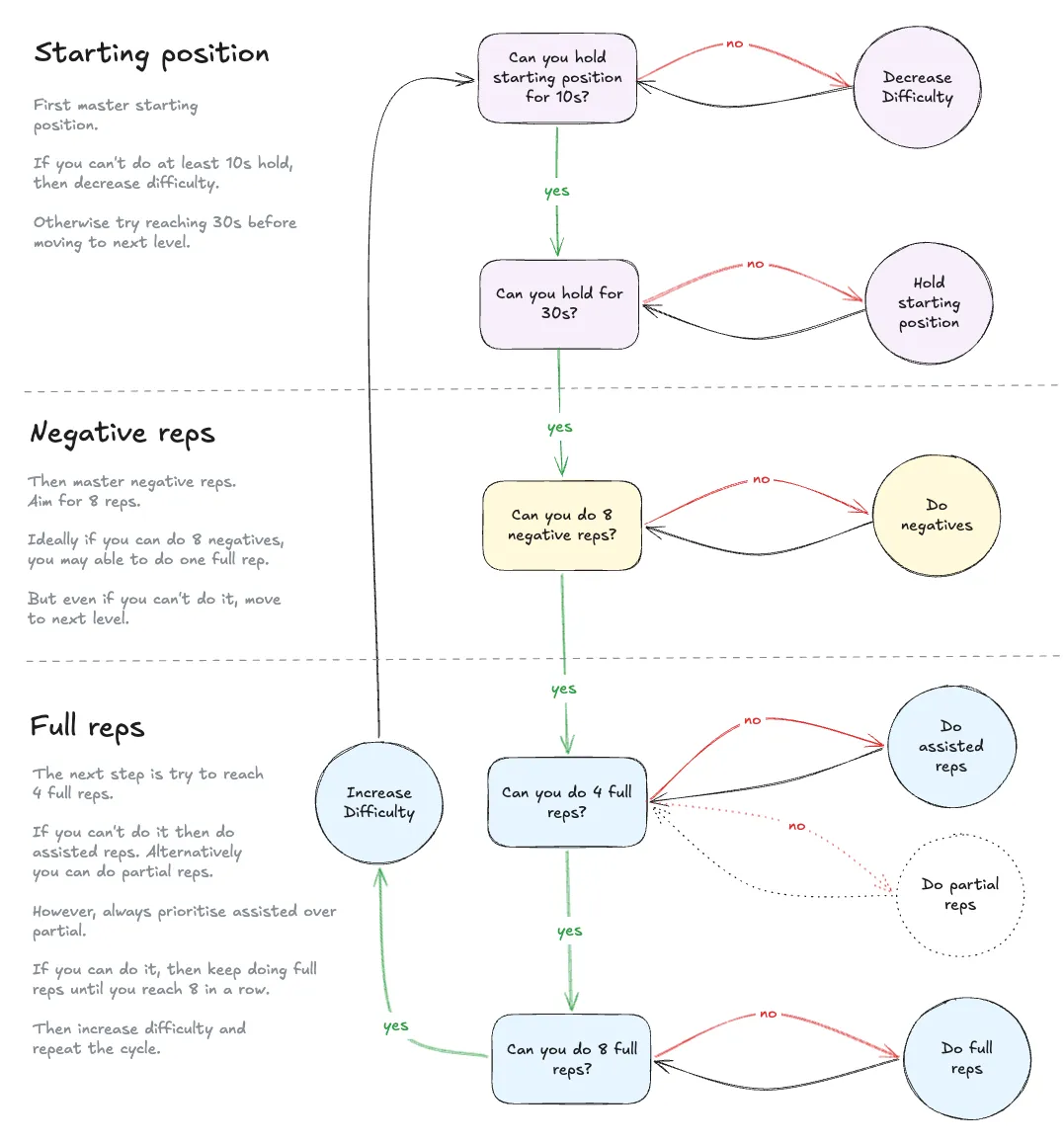
A calisthenics progression flowchart to help you progress when stuck on an exercise.
Master technique
Before adding reps, you can make any rep harder by improving technique, which includes:
Position
- how your joints and limbs are arranged relative to each other.Alignment
- how your body is oriented relative to gravity and force.Range of motion (ROM)
- how much of the movement you complete.Tempo
- the speed and timing of each phase.Movement path
- the route your body or limbs follow.Tension
- keeping full-body force transfer and stability.Bracing
- creating internal pressure and trunk stability to resist unwanted movement.Breathing
- coordinating your breath with movement and tension.Focus
- directing attention to improve execution and coordination.Don't chase reps
Do not chase rep count. Master the technique instead.
Bracing and breathing
There are 3 main types of bracing, and you need to choose the right one for each exercise.
Bracing and breathing can be improved over time, which is why they are part of technique.
Tension
During isometric holds, tension is a very important concept.
Each muscle or muscle group should contribute to full-body tension. The question is:
"How do we know how much tension each muscle needs?"
The video goes into more detail.
Develop the movement
There are a few ways to keep developing a movement:
Master the starting position
- this is a critical step.Partial reps
- add measurable partial reps.Negatives
- increase range of motion through a full, slow lowering phase.Assisted reps
- add assistance so you can move through the full range.Normal reps
- as it sounds.Deficit reps
- increase the range of motion even further.The video does not mention it, but you can keep progressing with:
Advanced reps
- increase difficulty by adding resistance, changing leverage, changing the distance between your arms or legs, or adjusting other variables once standard reps are no longer challenging.Increase volume
Progressive overload means gradually increasing the demand placed on your body over time.
Prefer low volume and high intensity
Aim for around
4
to 8
reps at roughly 80 to 90%
intensity, or about 1 to 2
reps short of failure. Once you reach 8
clean reps, increase the difficulty.For isometric strength exercises, aim for
10
to 30
second holds.While for lower intensity mobility exercises, aim for
30
to 60
second holds.You can also keep progressing by adding sets or reducing rest time.
Unlock skills
Increasing difficulty means modifying the same movement through leverage, resistance, range of motion, or position changes.
Unlocking a skill means progressing into a movement treated as a separate exercise, such as the handstand or front lever.
Mobility
Besides conditioning, mobility is the second most important thing in calisthenics. If you don't have enough range of motion, you may not be able to perform an exercise properly.
And if you try to perform it anyway, you may use compensations that can lead to injury.
So understanding how to train mobility is crucial.
Range of motion
Strength training is straightforward. You lift more weight, and you get stronger. Mobility, on the other hand, is more complex than that.
This video goes into more detail.
Programming
The best volume for mobility training is 2-3 sets per exercise at 50-60% intensity, using an 8-12 rep range or a 10-30-second hold if the exercise is hard.
Otherwise, use a 30-60-second hold if the exercise is moderate. Train mobility 3-4 times per week.
Weight loss
Most people who get into calisthenics also want to lose weight. There is nothing wrong with that, but understand that losing weight and building skills are two different goals.
You can pursue both at once, but training is not the main driver of fat loss - your diet is. Calisthenics builds and maintains muscle, while a calorie deficit is what actually reduces bodyweight.
Nutrition
I am not going to give you a diet plan, but a few basics go a long way:
Calorie deficit
- to lose fat, you have to eat fewer calories than you burn. This is the one thing that actually drives weight loss.Protein
- eat enough protein while in a deficit. It helps you keep muscle and recover from training. A common target is around 1.6
to 2.2
g per kg of bodyweight.Whole foods
- build most of your meals around minimally processed foods. They keep you fuller and make a deficit easier to sustain.Recovery
- your results are capped by your nutrition and sleep. You cannot out-train a poor diet.One goal at a time
If you are very overweight, prioritise the calorie deficit and basic conditioning first. If your main goal is a specific skill, make sure you are eating enough to recover and progress.
Equipment
Technically you do not need any equipment for calisthenics. Still, the right gear can make a big difference.
Pull-up equipment options
Pull-ups are a foundational exercise, so it helps to have a way to perform them. There are many options, from simple pull-up bars to full stations.
This video explains the main pros and cons of each.
Low-bar options
Low bars, sometimes called parallel bars, and most commonly known as parallettes, are great to have.
They let you train without putting excessive strain on your wrists, and they open up a wide range of exercises like push-ups, L-sits, handstands, and planche work.
You can still train most of these on the floor, but parallettes make them more comfortable and often more effective.